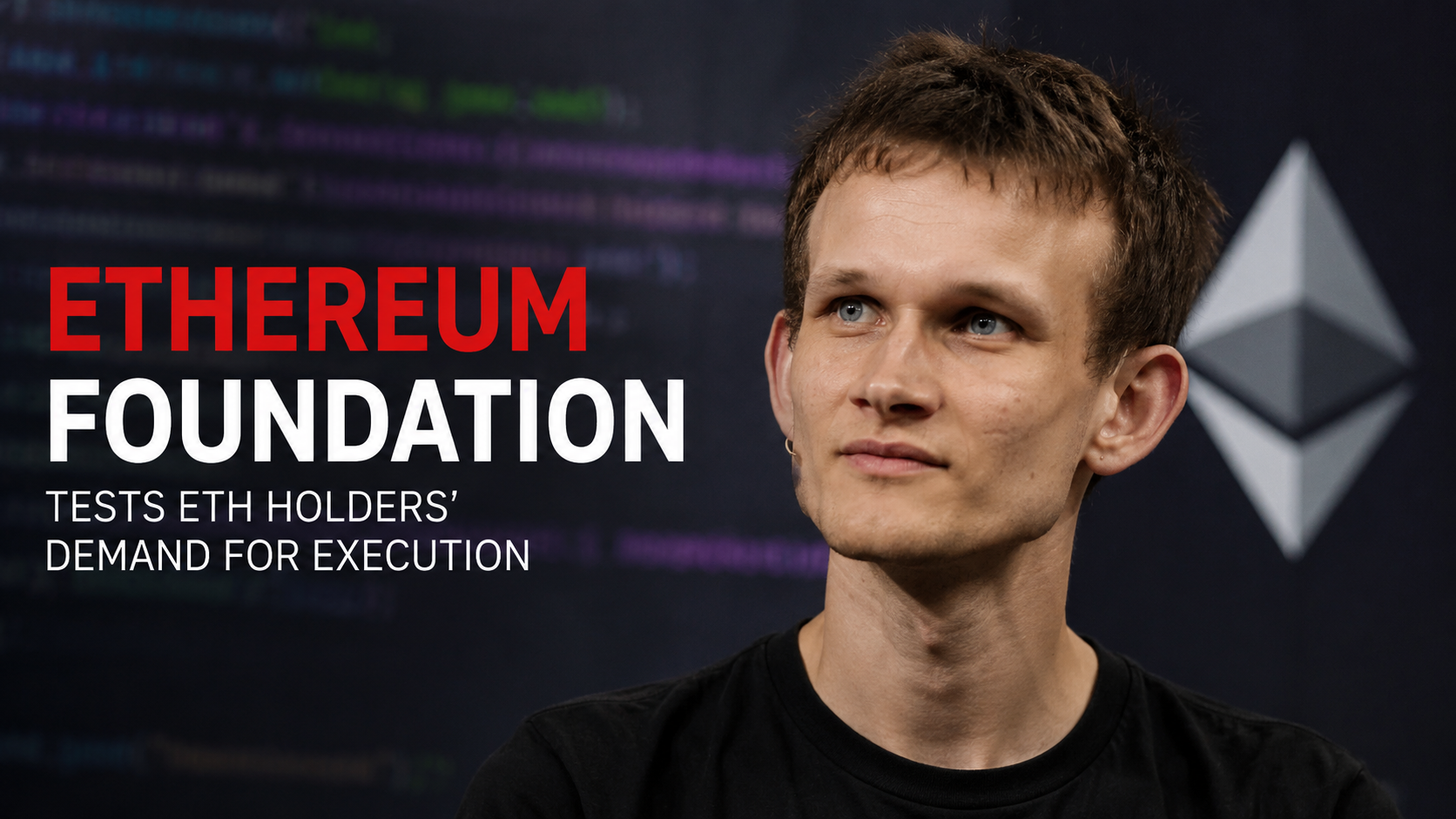
Vitalik Buterin
Russian-Canadian programmer (born 1994)
About Vitalik Buterin
Vitaly Dmitrievich Buterin, better known as Vitalik Buterin, is a Russian-Canadian computer programmer best known for co-founding Ethereum. Buterin became involved with cryptocurrency early in its inception, co-founding Bitcoin Magazine in 2011. In 2015, Buterin deployed the Ethereum blockchain with Gavin Wood, Charles Hoskinson, Anthony Di Iorio, and Joseph Lubin.
Vitalik Buterin is the closest thing crypto has to a public philosopher. More than a decade after he published the Ethereum whitepaper as a teenager, his essays still set the tone for how the industry debates scaling, governance, privacy, and legitimacy. He rarely holds a corporate title, yet his fingerprints are on nearly every major design decision in the second-largest cryptocurrency network.
Origins
Buterin was born in Russia in 1994 and moved to Canada as a child. He encountered Bitcoin in 2011, when his father told him about it, and within months he was writing for forums and co-founding Bitcoin Magazine. He studied briefly at the University of Waterloo, then dropped out in 2014 after receiving a Thiel Fellowship. That same year, he published the Ethereum whitepaper, arguing that Bitcoin's scripting language was too constrained — that a blockchain should be a general-purpose computer, not just a ledger.
Ethereum takes shape
The Ethereum network went live in July 2015 with a small group of co-founders, including Gavin Wood, Joseph Lubin, Charles Hoskinson, and Anthony Di Iorio. Many of those co-founders would leave or be pushed out over the following years; Buterin stayed. Ethereum's 2016 DAO hack — when an attacker drained roughly a third of the ether then raised for a decentralized fund — forced the community to choose between a contentious hard fork and preserving an "immutable" chain. Buterin backed the fork that became the Ethereum of today; the minority kept the original chain as Ethereum Classic. The episode set the pattern for how Ethereum governance would work: messy, public, and ultimately steered by Buterin's written arguments.
The Merge and rollup-centric roadmap
For most of Ethereum's history, Buterin's single largest technical project was moving the network from proof-of-work to proof-of-stake. That transition, known as "The Merge," finally happened in September 2022, cutting the network's energy use by more than 99 percent overnight. The move was years late on its original timeline, but it succeeded without a consensus failure, and it reshaped the climate argument against crypto.
Alongside the Merge, Buterin pushed Ethereum toward what he calls a "rollup-centric roadmap." Rather than scaling the base chain itself, the base chain becomes a settlement and data-availability layer while execution moves to layer-2 rollups like Arbitrum, Optimism, Base, and zk-rollups such as zkSync and Starknet. By 2026, that architecture is the dominant way most users actually transact on Ethereum, though it has also fragmented liquidity and user experience across dozens of L2s — a tension Buterin has repeatedly acknowledged.
Public intellectual
What separates Buterin from most protocol founders is how much he writes, and how willing he is to criticize his own ecosystem. His blog posts on quadratic funding, soulbound tokens, stealth addresses, proof-of-personhood, and "defense against 51 percent attacks" have become foundational reading. He has openly warned against the financialization excesses of DeFi, spoken skeptically about celebrity token launches, and pushed for privacy features at a time when most of the industry was chasing regulator approval.
He donates heavily: hundreds of millions of dollars to COVID-19 relief in India in 2021, and ongoing funding for longevity research, Ukrainian aid, and public-goods grants via Gitcoin. He has also been vocal about the failure modes of crypto culture, particularly the way memecoins and speculative cycles distract from the infrastructure work he considers Ethereum's real mission.
Controversies and critics
Buterin is not universally admired inside his own ecosystem. Critics argue that Ethereum's research-heavy culture moves too slowly, that his personal influence over roadmap decisions is undemocratic for a network that markets itself as decentralized, and that the Ethereum Foundation's periodic ETH sales depress the price. Others on the Bitcoin side consider Ethereum's repeated hard forks and monetary-policy tweaks proof that the network cannot credibly offer the kind of settlement assurances a sound money needs. Buterin typically engages these critiques in long-form essays rather than social-media sparring.
Where he stands in 2026
In 2026, Buterin is focused on three things: privacy (particularly via account abstraction and stealth-address primitives), further reducing the cost of L2 data via proto-danksharding's successors, and what he calls "d/acc" — decentralized acceleration, a philosophical counter to both AI-accelerationism and AI-doomerism. He still travels constantly, still writes in long, footnoted blog posts, and still lives largely out of a backpack. He holds enough ETH to move markets but has repeatedly signaled that he is not in crypto to get rich. The unresolved question about him is succession: Ethereum's culture leans heavily on his judgment, and no one in the ecosystem has yet emerged as a comparable voice. What happens to the project's sense of direction when Buterin eventually steps back is the question insiders discuss quietly but constantly.