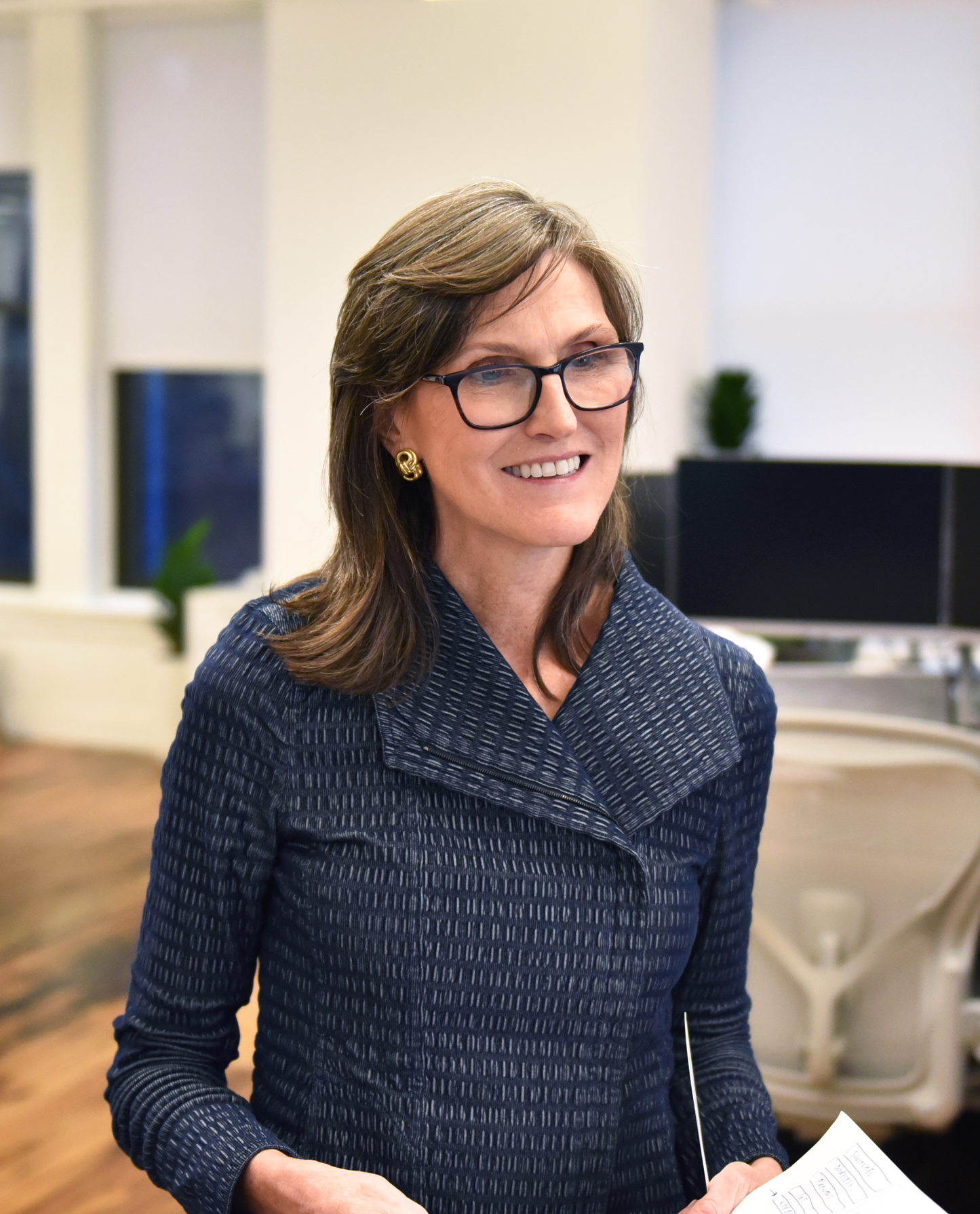
Cathie Wood
American investor and businesswoman
About Cathie Wood
Catherine Duddy Wood is an American investor who is the cofounder and chief executive officer (CEO) of Ark Invest, an investment management firm. Her funds have had mixed results over the years, and have been called rollercoaster rides.
Cathie Wood is one of the most visible active-management voices on Wall Street and one of Bitcoin's longest-standing institutional champions. She runs a thematic-ETF firm that became the symbol of both the 2020-2021 growth-stock bubble and the vicious drawdown that followed, and her views on crypto have been consistent enough to matter long past either cycle.
Origins
Wood was born in 1955 in Los Angeles to Irish immigrant parents. She studied finance and economics at the University of Southern California, where she was mentored by supply-side economist Arthur Laffer. She began her career at Capital Group in the late 1970s, moved to Jennison Associates, and later co-founded Tupelo Capital Management. She then spent over a decade as chief investment officer of global thematic strategies at AllianceBernstein, where she was a persistent advocate for treating disruptive innovation as an investable category.
Founding ARK
Wood founded ARK Invest in 2014, after AllianceBernstein rejected her proposal to launch disruptive-innovation ETFs. ARK's structure was unusual: transparent daily holdings disclosure, a single CEO and portfolio-manager voice, and active management delivered in ETF form at a time when the ETF market was overwhelmingly passive and index-based. Her marquee fund, ARKK, focused on companies she believed would be transformed by five convergent technology platforms: DNA sequencing, robotics, energy storage, artificial intelligence, and blockchain.
The Tesla call and the 2020-2021 boom
Wood's defining trade of the 2010s was Tesla. She projected a $4,000 pre-split price target (around $800 post-split) when the stock was trading below $200, was widely mocked for it at the time, and proved correct. That call — and ARK's strong pre-pandemic performance — set up the fund's explosive growth during the 2020-2021 pandemic tech boom, when ARKK became one of the most-discussed retail investment vehicles in the world and ARK's total assets briefly exceeded $60 billion.
Wood became a fixture on financial television, explaining her firm's research in long, calm, fact-dense interviews. She made specific long-range price projections — Bitcoin to $1.5 million by 2030, Tesla to $2,600 — and published detailed research notes supporting them.
The drawdown
The macro reversal of 2022 punished ARK's strategy with unusual severity. ARKK lost more than 75 percent from its peak as interest-rate rises decimated growth-stock valuations, and several of the fund's core holdings — Teladoc, Roku, Zoom — saw their business models revert sharply from pandemic peaks. Critics argued Wood had constructed a portfolio that was effectively a high-duration bet on zero rates forever. Supporters argued the drawdown was cyclical and that the underlying innovation thesis remained intact. ARK's assets under management contracted sharply but never approached zero; retail investors, remarkably, continued adding on the way down.
Bitcoin and the ETF race
Wood was one of the most persistent institutional advocates for a U.S. spot Bitcoin ETF. ARK filed repeatedly over multiple years, and when the SEC finally approved spot Bitcoin ETFs in January 2024, ARK's offering launched alongside products from BlackRock, Fidelity, and others. ARK's version — ARKB, a partnership with 21Shares — has since accumulated multi-billion-dollar assets, though it has generally trailed BlackRock's IBIT in total inflows. Wood herself has maintained a baseline Bitcoin price target of $1.5 million by 2030, with higher bull-case scenarios, and has repeatedly argued that Bitcoin is the most important innovation in money in centuries.
Broader crypto views
Wood has been more crypto-curious than crypto-maximalist. ARK's funds have held Coinbase and Block as core positions, both of which took heavy losses during the 2022 drawdown. Her research has covered Ethereum, stablecoins, and on-chain AI, though her personal advocacy has remained anchored to Bitcoin. She has generally been skeptical of memecoins and of speculative token launches, framing them as distractions from the more durable layer-1 and infrastructure opportunities.
Controversies
Critics argue that Wood's price targets are aspirational rather than rigorous, that her portfolio construction ignores position-size risk, and that her insistence on transparency — publishing daily trades — has at times disadvantaged her own funds by letting others front-run. Her funds' high beta to risk-on conditions makes them unusually volatile for ETFs. Defenders counter that her transparency is a genuine service to retail investors, that her long-term returns since inception remain competitive, and that the intellectual honesty of her research process is unusual among active managers.
Where she stands in 2026
In 2026, Wood is still running ARK, still publishing research, and still a regular presence on financial television and podcasts. Her funds have partially recovered from the 2022 lows, though not fully to 2021 peaks, and AI-focused themes have overtaken some of the pandemic-era positions. Her Bitcoin thesis has been partly validated by the ETF launch and the subsequent institutional flows, even if her specific dollar targets remain unverified.
The unresolved questions around her are about whether thematic active management at scale is a durable product category. ARK remains one of the very few active ETF franchises with a public-facing analyst-CEO, and the question of what happens to the firm's asset base in another sustained drawdown is open. For crypto specifically, Wood's role is less about moving markets short-term and more about providing a respected traditional-finance voice arguing for Bitcoin as an asset class — a role she has played longer and more consistently than most. Whether her long-dated price targets are eventually vindicated or quietly retired, her presence has helped normalize Bitcoin exposure for a generation of financial advisors and retail investors who would otherwise never have engaged with the asset.